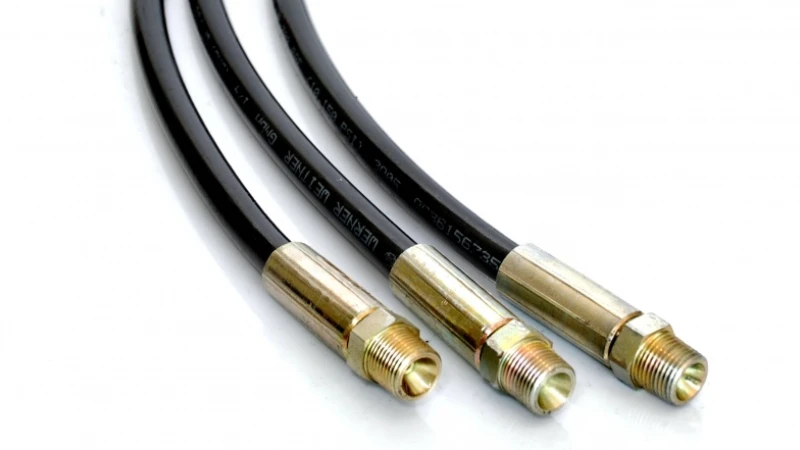
Choosing a professional hydraulic hose supplier helps companies reduce equipment downtime, improve safety, and maintain stable hydraulic performance. Professional suppliers provide hoses tested under standards such as SAE and ISO, with pressure ratings often ranging from 70 to more than 420 bar. They offer accurate hose selection, custom assemblies, material traceability, and technical support, helping industrial users achieve longer service intervals and lower maintenance costs.
Hydraulic systems depend on hoses to transfer pressurized fluid between pumps, valves, cylinders, and actuators. Although hoses usually represent a small part of the total machine cost, their performance affects the reliability of the entire system. In industries such as construction, mining, agriculture, and manufacturing, hydraulic hoses may operate for thousands of hours each year under vibration, temperature changes, and repeated pressure cycles.
A hydraulic hose failure can stop equipment operation within minutes, while a properly selected hose can support stable performance through millions of pressure changes during its service life.
A professional supplier provides more than standard hose products. It evaluates working pressure, fluid compatibility, temperature range, bending radius, installation space, and mechanical conditions before recommending suitable products. For example, SAE 100R1 hoses are commonly used for medium-pressure applications, while SAE 100R12 and SAE 100R13 designs are developed for higher pressure systems that require stronger reinforcement.
The manufacturing process also affects hose reliability. High-quality hydraulic hoses usually include several layers: an inner tube that contacts hydraulic fluid, reinforcement layers made from textile or steel wire, and an outer cover designed to resist abrasion and environmental exposure. Modern production lines control extrusion thickness, wire placement accuracy, and rubber curing conditions to maintain consistent performance.
Many professional suppliers follow international standards developed by organizations such as SAE International and ISO. Since the introduction of SAE hydraulic hose specifications in the 20th century, these standards have been updated continuously to match higher pressure equipment requirements. ISO 18752, released in 2006, defines performance requirements for constant pressure hydraulic hoses used in industrial and mobile machinery.
The difference between a general seller and an experienced supplier is often reflected in testing procedures. Professional manufacturers normally conduct pressure tests, impulse tests, leakage checks, and dimensional inspections before shipment. A hydraulic hose designed for heavy machinery may need to pass hundreds of thousands of impulse cycles to confirm resistance against repeated pressure changes.
A supplier with complete testing records can provide information about production batches, pressure ratings, and material performance instead of only providing a product name and size.
Material selection is another important factor when choosing hydraulic hose solutions. Different hydraulic fluids require different inner tube materials. Petroleum-based oils, water-based fluids, and biodegradable fluids can interact differently with rubber compounds. Selecting an incompatible hose material may reduce service life by more than 50% in demanding applications.
Professional suppliers usually maintain a wider product range to meet different operating environments.
| Hose Type | Common Application | Typical Pressure Range |
|---|---|---|
| SAE 100R1 | Industrial equipment and general hydraulics | Around 40–250 bar |
| SAE 100R2 | Construction machinery and mobile equipment | Around 160–400 bar |
| SAE 100R12 | High-pressure machinery systems | Around 280–420 bar |
| SAE 100R13 | Heavy-duty hydraulic equipment | Above 350 bar |
The correct hose structure depends on the working conditions. Construction equipment often experiences strong vibration and frequent movement, so hoses require high flexibility and abrasion resistance. Mining equipment may operate in dusty environments with sharp materials, requiring thicker outer covers and stronger reinforcement layers.
A professional supplier also helps customers avoid common installation problems. Hydraulic hose failures are not always caused by manufacturing defects. Incorrect routing, excessive bending, unsuitable fittings, and poor assembly practices can shorten service life. Studies from industrial maintenance programs have shown that installation-related problems account for a significant percentage of hydraulic system failures.
Proper assembly requires matching the hose with the correct coupling. The fitting must provide secure connection without damaging the reinforcement layer. Professional suppliers usually use controlled crimping equipment and verify assembly dimensions according to manufacturer specifications.
A hose assembly is only as reliable as the connection between the hose and the fitting.
Customization services are another advantage of working with professional suppliers. Different machines require different lengths, connection angles, and fitting types. A supplier with engineering capabilities can produce assemblies according to equipment drawings or field measurements, reducing installation difficulties and improving system layout.
Industries with strict production requirements often depend on stable supply chains. Automotive plants, aerospace facilities, agricultural equipment manufacturers, and energy companies need consistent hose quality across multiple production locations. A supplier with standardized manufacturing processes can maintain product consistency between different batches.
Quality documentation is also important for large industrial users. Professional suppliers may provide inspection reports, pressure test results, and production information for each batch. This information supports maintenance planning and helps engineers identify suitable replacement parts.
Cost considerations should include long-term operating conditions rather than only purchase price. A lower-cost hose may require more frequent replacement if it cannot withstand the application environment. If a machine operates 10 hours per day and a hose failure causes several hours of downtime, replacement costs can exceed the original hose price many times over.
Professional suppliers also invest in research and product improvement. Hydraulic equipment manufacturers continue developing systems with higher pressure, smaller installation spaces, and improved energy efficiency. Hose technology has followed this trend through improved rubber compounds, stronger reinforcement materials, and lighter designs.
Environmental requirements have also influenced hydraulic hose development. Since the 2010s, many industries have increased the use of biodegradable hydraulic fluids and equipment designed for lower environmental impact. Hose materials must maintain sealing performance and mechanical strength while supporting these new fluid types.
Supplier experience is another factor that affects product selection. Companies that have served multiple industries usually understand different application conditions, including temperature extremes, outdoor exposure, continuous operation, and high-frequency movement. This practical knowledge helps customers select suitable hose designs without unnecessary replacement cycles.
When selecting a hydraulic hose supplier, companies should review several factors:
| Evaluation Area | What to Check |
|---|---|
| Manufacturing capability | Production equipment, quality control process |
| Standards compliance | SAE, ISO, and industry certifications |
| Testing ability | Pressure, impulse, leakage, and material tests |
| Custom service | Hose assembly, fittings, special requirements |
| Technical support | Product selection and installation guidance |
A professional hydraulic hose supplier supports equipment reliability through engineering knowledge, controlled manufacturing, and consistent quality management. For companies using hydraulic systems in demanding environments, choosing a supplier with proven production capability can improve machine availability, reduce maintenance frequency, and support safer long-term operation.